
In the temporary construction industry, transportation and storage costs are often a significant part of the overall project costs. Traditional one-piece containers, despite the advantages of modular construction, still take up a lot of space when transporting long distances or storing large quantities. The advent of collapsible containers is designed to solve this problem: thanks to their folding design, they take transportation efficiency to a whole new level.
Folding design, drastic reduction of transportation costs
The main innovation of folding containers lies in their folding frame construction. When transported unladen or stored, the container body can be compressed to one-quarter or even one-fifth of its original height, and multiple folding containers can be stacked tightly on top of each other, allowing 4-5 times more containers to be loaded on a standard flatbed truck than traditional one-piece containers.
This design is of particular importance for overseas engineering projects, the development of remote areas and the construction of large camps. The significant reduction in transportation costs means that the overall budget for temporary project facilities can be effectively controlled. In addition, the folding containers can also be folded during return transportation, further increasing the economics of turnover.
Robust construction without compromising on performance
Some may be concerned that the folding design will affect the strength and durability of the container. In fact, high quality container manufacturers use reinforced hinge assemblies and locking mechanisms in the folding container design to ensure stability and rigidity of the structure once deployed. The corner pieces, posts and bottom frame are made of high-strength galvanized steel, providing strength comparable to standard containers.
In terms of thermal insulation and fire resistance, folding containers are also not inferior to standard containers. Wall and ceiling panels can be equipped with mineral wool or polyurethane filler from 75 to 100 mm thick, which meets the requirements for thermal insulation in regions with harsh climates. Doors, windows, water and electrical piping are pre-installed at the factory, so once deployed on site, it is sufficient to connect water and electricity to make the container ready for use.
Quick assembly, one-person operation
Another important advantage of folding containers is the ease of installation. Traditional containers require lifting equipment for installation, whereas collapsible containers can be unfolded and folded with simple mechanical devices or even by hand, even if lifting equipment is not available. One worker with small tools can unfold or fold one container in a few minutes.
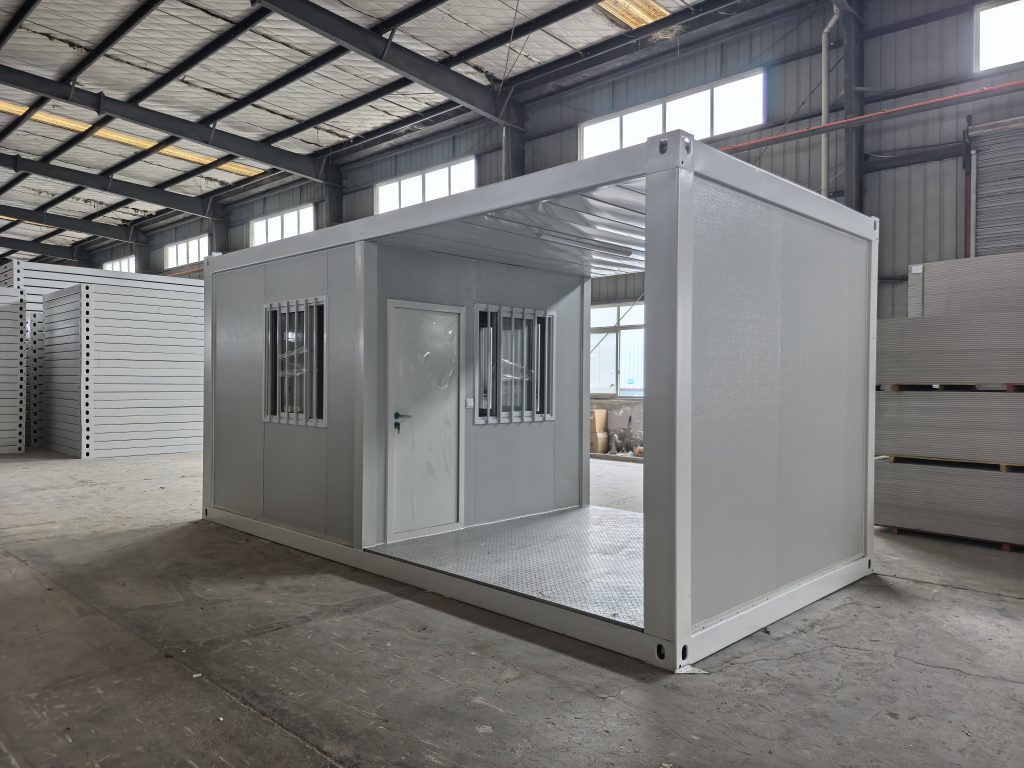
These characteristics make folding containers particularly suitable for the following scenarios:
Temporary checkpoints or posts: require rapid deployment under limited site conditions
Exploration field camps: frequent movements, high demands on transportation and installation efficiency
Emergency accommodation: temporary facilities that require rapid deployment in large numbers when recovering from natural disasters or emergencies
Overseas projects: long-distance maritime transportation with strict requirements for container loading
Multifunctional application, flexible adaptation
Stackable containers, like standard containers, can be combined according to need to create spaces for offices, housing, conference rooms, warehouses and other uses. A single container can serve as a construction site office, worker's dormitory or equipment storage; multiple containers can be joined horizontally to form a row or stacked on top of each other to create a two-story structure.
In terms of functional configuration, folding containers also support customization. A separate bathroom, electric heating system, air conditioner, fan and other equipment can be installed in them to meet the needs of use in different environments. The color of wall panels, the location of doors and windows, and interior finishes can be adjusted according to customer requirements.
How to choose a reliable folding container manufacturer?
The complex designs of folding containers exceed the complexity of traditional containers, so higher demands are placed on the technical capabilities and quality control of the manufacturer. It is recommended to pay attention to the following points when making your selection:
Hinges and locking mechanisms: the material and workmanship of key components have a direct impact on the service life and safety of the folding container
Airtightness: multi-layer sealing at the bending points provides good protection against water and dust once the container is deployed
Ease of unfolding/folding: smooth operation, no need to use special tools
Thermal insulation: selection of sandwich panels of suitable thickness taking into account the climatic conditions of the project location
Certificates and test reports: availability of documents confirming the safety of the structure, fire resistance class, etc.
Container manufacturers with experience in large projects, especially with export opportunities, tend to provide a higher level of assurance on the above aspects.
Conclusion
Folding container homes are becoming an important segment in the temporary construction industry due to their superior transportation efficiency, stable structural characteristics, and ease of quick assembly. Whether building large camps or deploying small temporary sites, choosing a high-quality containerized house can help a project achieve better cost control and improve operational efficiency.
When making your choice, contact an experienced container home manufacturer to ensure that professional design and manufacturing will provide solid support for your project.
 Phone:+86 13551309988
 Mailbox:cnsiteoffice@yandex.ru
 Address:Yang'an Industrial Park, Qionglai Town, Chengdu City, Chengdu, Sichuan Province, 16 Henliu St.


